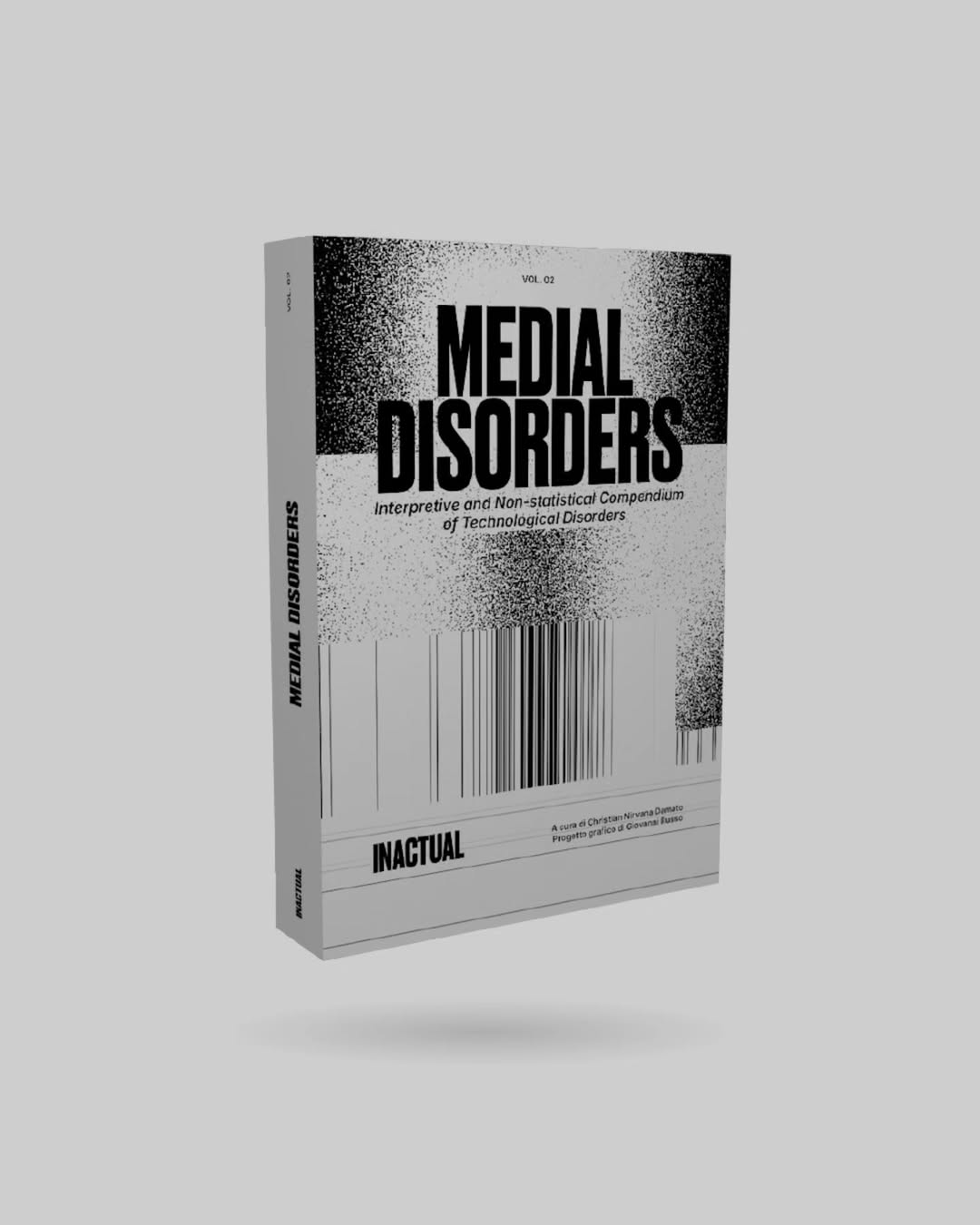
Translation of an article included in Medial Disorders Vol. II, Christian Nirvana Damato (ed.).
17/06/25. According to Thomas Mann, “a writer is someone for whom writing is more difficult than it is for other people”. And since the less you write, the less you risk making mistakes, in an age of prefab textual credibility, the true word is the brief one, and must therefore be sought in aphorisms, quips and wisecracks.
10/06/25. In 1860, Delphine de Girardin welcomed the advent of photography with the following words: “At present much attention is being paid to Mr. Daguerre’s invention, and nothing is more comical than the serious elucidations which our salon scholars are giving of it”. Technologies change, scholars do not.
12/10/23. The images generated with the help of artificial intelligence are doubly retrospective. First, they are retrospective in a technical sense, as they are extrapolated from a pre-existing dataset. To a certain extent, this applies to any image, since reality is the ultimate database, but datasets are marked by a precise threshold: the records they contain, for example, may stop at 2021. Second, these synthetic images are retrospective in a cultural sense: looking at them, one already has the feeling that today’s fad will be obsolete after the weekend. This gives rise to various attempts to explain, connect, comment on, serialize, catalog, musealize… In short, justify these images. Through a DIY canonization, we try to save them from the looming abyss.
07/10/23. Jean Baudrillard on Midjourney (1994): “Art has become iconoclastic. Modern iconoclasm no longer consists in destroying images, but in manufacturing a profusion of images where there is nothing to see. These are literally images that leave no trace. They have no aesthetic consequences to speak of. However, behind each of them, something has disappeared. There lies their secret, if they have one, and there lies the secret of simulation. On the horizon of simulation, not only has the real world disappeared, but the very question of its existence has no meaning.”
11/10/23. To dismiss the naive faith in the Death of the Author, it suffices to point out that the essay was signed, in 1967, with the author’s full name.
05/01/24. Working with Midjourney is like running into an overly proactive Starbucks barista. “I’d like a coffee”. And they bring you a Caramel Macchiato. “But I didn’t want caramel”. So they bring you an Espresso Macchiato. “I’m lactose intolerant”. A little impatient, they bring you a Coffee Americano. “But there’s too much coffee here”. Now visibly annoyed, they bring you a Sugar Cookie Almondmilk Latte. “Who asked you that?!” “That’ll be $14.99” – and they go on misspelling your name on the cup.
20/03/24. the activity which comes the closest to synthetic image generation is neither painting, nor photography, nor photo editing, but image search. The practices are similar: both involve entering a string of text and a few parameters. Moreover, one activity flows into the other: what is the generative act if not an immense, probabilistic image search? And viceversa: it has become difficult to do a search online without running into a good deal of synthetic junk.
08/03/25. The virtual Ctrl+Z represents the point of no return in the adoption of a technology. Who hasn’t instinctively hit undo in their mind after writing the wrong word on a piece of paper? Only to realize that the function is not available, and feel a sense of frustration and confusion, a bit like in a déjà vu. Artificial intelligence has long since crossed that threshold.
07/09/23. Among the effects of the current use of generative artificial intelligence, there is one that can be summarized as follows: the inversion of the image-caption relationship. This unprecedented reversal of ekphrasis means that when a work is published (and this is where the use of the tool is duly declared), it is not the text that “explains” or “describes” the image, but rather the generated image serves as a back up to, in turn, the given prompt, the software experiment, the illuminating anecdote, the general thesis on contemporary media. It is no coincidence that many academics and writers have embraced the art of prompting: text is and remains their comfort zone. The image, on the other hand, plays an ancillary role. This is why images generated with AI and published on social media always feel a bit like placeholders. Even when the text in question is missing, its absence is felt: what did the “prompt engineer” (bogus technicality) type to concoct such an image?
15/10/23. They argue that the idea of authorship is a “bourgeois superstructure”, and then in their work, in their ideas and in their poses, they wear the most common and worn-out authorial clothes, while we have been adopting for years the tactical point of view of widespread and anonymous production – the very production that feeds the false consciousness of those authors who are ashamed of being such.
28/03/25. The most irritating thing about the current AI-gitprop is its depressing common sense. Those who spread it are very similar to the tools they test: they always express themselves in the most appropriate and correct terms, especially when discussing Art – them of all people! As aesthetic as a gentrified cafe, as technical as a provincial lawyer, philosophical in an abstract and conciliatory way, as subversive as a bad rebranding. And just like the models they admire, they are unable to distinguish between different registers and levels of discourse. Like the bot that mistakes a muffin for a puppy’s snout, they interpret witticisms literally, are immune to paradox, and fail to grasp the core of arguments, nipping interesting ideas in the bud. It would seem that they lack an unconscious. They are STEM in soul and spirit: no retraining will redeem them.
14/04/25. “When a wise man points at the moon the imbecile examines the finger”. However, in the age of artificial intelligence, the hand can have as many as seven fingers.
13/04/25. Controversies surrounding the Argumentative Inevitability (AI). Among AI advocates, a kind of self-defeating common sense prevails (“a work of art is always a collective effort”). Among those whom AI supporters cast as anti-AI, flashes of brilliance occasionally emerge (“AI releases make the same impression the air fryer makes on the elderly”). It should be clear, then, where one ought to stand.
25/05/25. Leonardo Sinisgalli in 1970: “An intelligent machine can produce stupid objects. So often intelligence finds itself entangled with idiocy”. Even the title of the book from which the quote is taken is prophetic: Calculations and Nonsense.
04/01/24. In one of his books, Riccardo Falcinelli notes (I paraphrase from the top of my head) that images cannot represent absence. In other words, it is impossible to produce a non-conventional image capable of saying “the tree is not there”. Generative artificial intelligence simply extends this inability: not only can it not indicate the absence of the tree, but one must also jump through hoops to ensure that the tree meant to be absent is not a pine, not lush, not painted, not in the foreground, and so on.
13/05/24. The formula that pits artificial intelligence against natural stupidity is already trite. Yet there is a short essay by Ando Gilardi, dedicated precisely to photographic stupidity, which neatly sums up the great mistake made by those – not all, but almost all – who make art with artificial intelligence: “Photography is bigger than us and is only minimally dependent on us. It is often capricious, sometimes even hates us. Occasionally, I get the impression that it pulls our leg. But this doesn’t really happen exactly to fools, who are always persuaded that they are the ones taking the pictures”.
29/12/23. Assuming it exists at all, art in the age of artificial intelligence is not to be found in the images cobbled together with Midjourney: those paintings, illustrations, and “series” complete with titles that circulate as if they were works of art. It resides instead in Discord’s novitiate, where endless variants of mediocre images, emojis framed by flat buttons, notifications from phlegmatic bots, and strings of text that read like fragments of modernist poetry accumulate in an endless flow. River against stone, event against object, user against author: becoming is what is real; the work is the illusion.
20/04/24. What should one read to free oneself from preconceived ideas about AI images –and why, precisely, Franco Vaccari’s essays? Roberta Valtorta puts it succinctly: “Vaccari grasps the enormous potential of the camera when it is not used and steered in a forced ‘artistic’ or deliberately ‘creative’ way (ultimately pictorial), but – more freely – left to operate as a device capable of producing recordings and memories independent of the operator’s intentions and abilities, and thus remarkably powerful in checkmating (I use this term with Duchamp in mind) visual and behavioral norms, private and collective alike, whether they derive from personal histories or from conditioning induced by the media and by the powers that be”.
11/04/25. The best example of “style transfer” is not done with artificial intelligence, it is not the ghiblization of a banal selfie but the hand-made rendering in “flat style” (also called Corporate Memphis) of a Goya painting. The vectorized Saturn Devouring His Son is more blunt and profound than any output of OpenAI’s anime engine because it is not a simple stylization but a reflection on the logic of stylization, that is, on its conceptual innovation, which for some is violence or imposture. The flat Saturn shows us how the corporate imagination infantilizes reality, producing a flattening of signs, contexts, and registers into a generic “niceness” á la Google/Alphabet. The point is not that synthetic images are right-wing (although it is well possible to add a cutesy touch to photos of deportations), but rather that they are transversal in a totalitarian and totalizing way, universal as multiculturalism has been, that is, according to a very partial idea of the universe, thus both oleographic and stylized, but always within the shifting parametric boundary of the stylized and the oleographic. The generation of an image “in the style of” is therefore a triumph: the triumph of postmodern vertigo, pastiche elevated to the syntactic level; and I do not say this as an accusation: there is indeed something exciting and somewhat liberating about this new technical possibility. But it would be unfair to deny a sense of loss. In a few days all this has become normal, and we already struggle to remember the time when that vase of sunflowers always corresponded only to those dense brushstrokes – as if they were two separable entities, save through an artificial caesura… there it is, I already think in the “paratactic” terms of style transfer, I conceive formal features and content elements as a list or summation. It’s a new archaic style: warrior’s body + death = the same body placed horizontally. The question then becomes: what could hypotaxis be in the times of style transfer? What other operations are possible besides addition – assuming they are possible at all. We talk about future and revolution, but we have ended up, who knows how, in the time of myth.
22/12/23. This new “make it more” trend – in which users push AI image generation to the limit by asking ChatGPT to imagine, say, a spicy ramen and then ask for a spicier one ad infinitum – condenses the whole logic of synthetic image production: more intricate, more dreamlike, more absurd, more improbable, more weird. And then more still: more photorealistic, more virtuosic, more hi-res, more picturesque, more vintage, more macro, more micro. Here is where the prurient nature of prompting (pornographic, as it would once have been called) becomes visible: its dominatrix-like commands are only ostensibly inputs, yet they also function as outputs, as shown by the dialogues with the machine that users publish in full (voyeurism). To each their own perversion.
14/12/23. Since artificial intelligence beats us at detailed and intricate images, the next post-digital romantic reflex will be a return to simplicity, to childishness. In short, we will reclaim a candor á la Rousseau. Generative tools promise to turn our doodles into masterpieces? Then we will make a masterpiece of our doodles. Museums will stock up on Art Brut, we will be deeply moved: sentimentality will reach new heights.
08/12/23. The fight against artificial intelligence is tragic, because it is lost from the outset. The fight in its favor, by contrast, is pathetic, because its victory is assured – and thus it is not a fight at all.
27/12/24. Rather than AI Art, it should be called Paid Subscription Art.
22/04/25. Theory of cultural responsiveness. A web page is considered responsive when its layout adapts to different screens – say, by rearranging its sections vertically to fit the proportions of a smartphone. In the past, this approach was applied experimentally to content: the headline of a news article could change depending on the device (longer on a desktop, shorter on a phone). At first, the laptop was the primary device and the phone a secondary one; over time, however, the roles reversed, compromising performance on larger displays. Today, with artificial intelligence, we can extend the idea of responsiveness to cultural contexts. A text drafted in a colloquial voice can be automatically converted into an academic one to respond to the university context. For reasons of time and effort, this may lead us to select a single primary output while delegating all secondary versions to AI – accepting that these will be imperfect. Could this be the right time to get rid of some rhetoric, at least in our writing?
26/02/25. Chinese walls of text, billions of word – written and spoken – about the obscene tourist plan for the current theater of genocide, whose propaganda clip was likely conceived, commissioned, and produced in a matter of hours. An immense waste of resource, not only computational or hermeneutic, but above all cognitive, strategic, moral. It almost seems as if we crave the obscene. And the sloppiness that characterizes it only makes it more appealing.
09/03/25. Human attention is a scarce resource, while the production of artificial intelligence is unlimited. Therefore, we must ensure that the latter does not deplete the former.
14/06/25. What do AIs do? According to Salvatore Iaconesi and Oriana Persico, “they do with data what we do with clouds: look over there, is it a bunny or a man with a beard?” Distracted by the game, we don’t mind the impending storm – so we end up home drenched.
02/08/23. I’ll offer my two cents on artificial intelligence in due course, that is, once everything is done, the singularity has finally been achieved and whatever I’ll say then will be no less useless, indeed entirely useless and therefore perfectly appropriate, than saying the very same thing now.