Text of a postcard sent to Pelle Ehn, a pioneer of Scandinavian Participatory Design, for his “Utopian Epistles” project.
Dear Pelle,
you ask what kind of joy there can be – and whether there can be any – in acting during these dark times, when the spectacle of war takes center stage, authoritarian impulses know no restraint, and people tend to feel small and impotent. How to act joyfully when the world is on fire? The question sounds almost obscene.
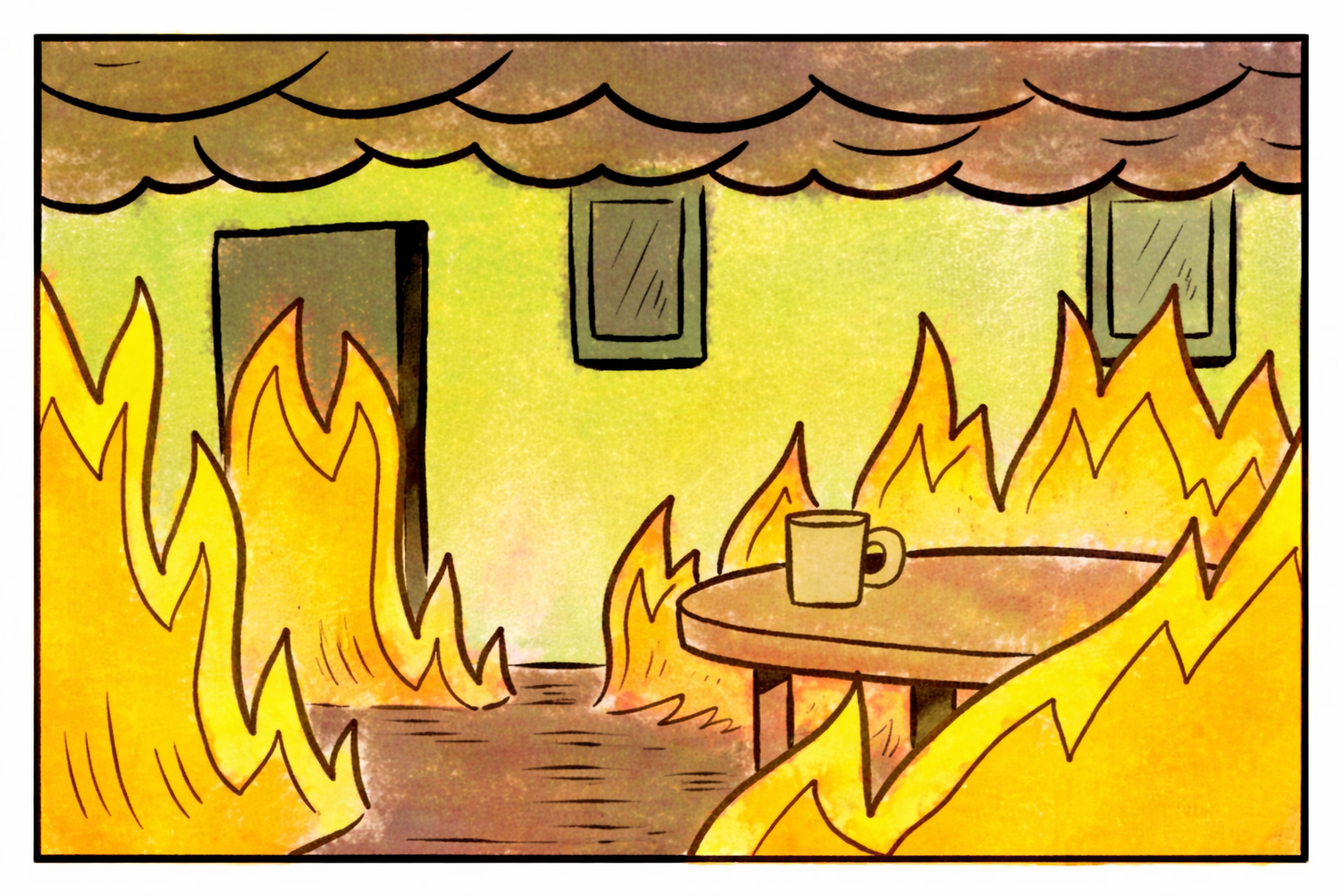
“The world is on fire”. You might have noticed that this expression is now deployed rhetorically in talks, papers, and conferences, often paired with This Is Fine, a meme that shows an idle, faintly perplexed dog sipping coffee while the house burns around them. What the expression really does is set priorities straight. It is a reminder that while we are busy with our petty concerns – the counterform of a logo, the bevel of a CSS button, the curve of a font glyph – more pressing, paramount issues are unfolding in the world.
Its main effect, of course, is to cast our everyday efforts – the modest work we have at least some control over – as trivial and insignificant in the grand scheme of things. To cope with meaninglessness, the culture industry sets out to tackle the grand scheme directly. But without a concrete, specific entry point, the best it can do is reiterate ethical platitudes: war is bad, peace is good, democracy matters. Call it Miss Universalism.
My disillusionment with this cultural tendency – as always, born of the gap between expectations and reality – keeps bringing me back to Karl Kraus, an essayist and biting aphorist, a longtime friend of Adolf Loos and a relentless critic of the cultural decadence of his time, of every kind of decadence, including the grotesque descent into the folly of World War I, which he chronicled in The Last Days of Mankind.
Here is how composer Ernst Krenek recalls meeting, in 1932, the founder and publisher of Die Fackel: “At a time when people were generally decrying the Japanese bombardment of Shanghai, I met Karl Kraus struggling over one of his famous comma problems. He said something like: ‘I know that everything is futile when the house is burning. But I have to do this, as long as it is at all possible; for if those who were supposed to look after commas had always made sure they were in the right place, Shanghai would not be burning’”.
I believe that overcoming disillusionment, and even finding joy in one’s activity, begins with discovering – or rather, choosing – one’s own “comma problem”, and looking after it. Joy comes from love, and for amor mundi, the love of the world, to be real, it cannot be passion for an abstraction but for the bits and pieces of the world we inhabit, however small, since these are the only things we share with others and can genuinely tend to. They are the world.
With joy,
s