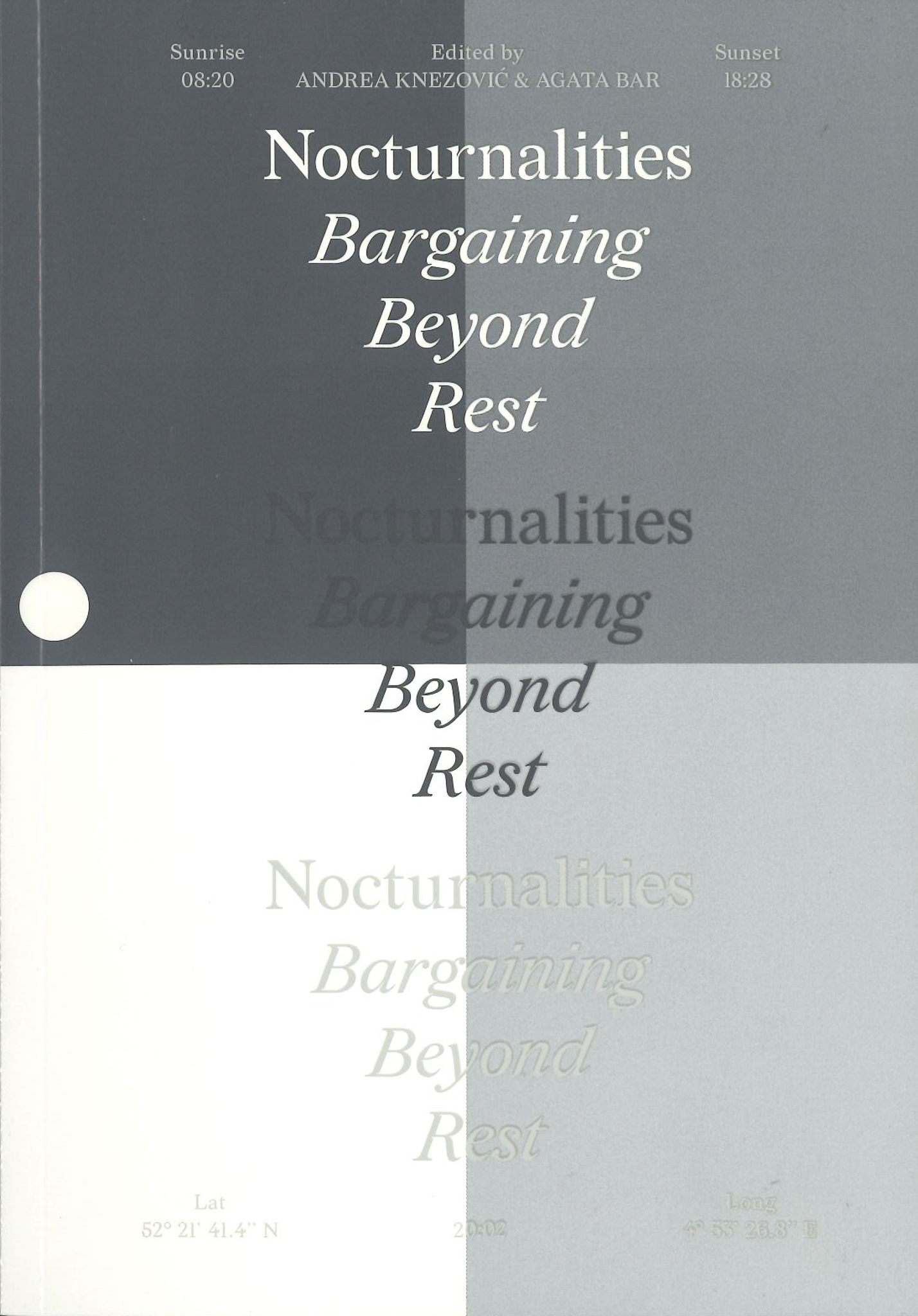
Article included in Nocturnalities: Bargaining Beyond Rest edited by Andrea Knezović and Agata Bar (2025).
I don’t like the colour white for two reasons: first, I get dirty when I eat, like a child; second, I have floaters in my eyes. When I look at a white wall, I feel a bit sad as I become aware of these elusive particles that traverse the aqueous humour of my eyes, casting their ominous silhouette on the canvas of the retina. Generally referred to as eye floaters or muscae volitantes (Latin for ‘flying flies’), these diaphanous shadows become particularly visible against the backdrop of a blue sky or an empty Word document. Perverse irony, since they are partly caused – it seems – by the extended exposure to screens. The symbiotic relationship between screens and vision is, in fact, what I want to explore in this short essay. I want to look at the eye itself as a screen, and consider the behaviours and feelings provoked by a mild yet permanent alteration of one’s vision.
“Floaters may seem to be alive, since they move and change shape, but they are not alive.”1 This is how an educational YouTube video explains the flies in my eyes. Mine mostly look like semi-transparent squiggly lines, but they can have different shapes such as spots, rings, or even cobwebs, like those of a cheap, black and white horror movie. Floaters are small concretions of collagen stuck in the vitreous body of the eye, moving gently like the snow in a snow globe. They are not to be confused with moving dots of light followed by a black tail, an anomaly known as blue field entoptic phenomenon, which is in fact the opposite of floaters, since the latter are shadows and the former is light. Myodesopsia, the perception of floaters, is not uncommon: a 2002 UK survey indicated that, on average, fourteen patients every month reported floaters symptoms to their optometrist.2
There is no known unintrusive remedy for eye floaters, and so they are almost never treated. Generally, a doctor would tell you that the brain will eventually ‘tune them out,’ but it is hardly able to, since floaters don’t have a fixed position within the eye. So, tuned out or not, you have to learn to live with them. Some companies have promoted laser vitreolysis as a solution but, despite the aggressive marketing, there’s currently insufficient evidence supporting the use of such technique for treating floaters. While searching for therapies, I stumbled on ‘the floater doctor’ who uses laser and promises to take the issue seriously – unlike the American Academy of Ophthalmology.3 Another oculist from Hawaii offers a review of a Taiwanese study suggesting that a pineapple-based diet might alleviate the condition.4 I like pineapple, so I might give it a try. Better than laser anyway.
The time when my floaters appeared was a hard one for me. I was 27 and didn’t have a very good work-life balance. I also didn’t have much money, I wasn’t eating well, and I was glued to the computer screen. I felt tired. On top of it, I had just started a master’s programme that required me to spend even more time in front of the screen, since the programme mostly revolved around coding. Of that period, I remember harsh migraines, inconclusive plans to come up with a computer-free career, and a general sense of misery.
In one of his novels, Emmanuel Carrère tells the story of Erica, a middle-aged woman affected by a stroke. Frequently, all of a sudden and out of nothing, she turns her head to the left because she feels there is a shadowy presence there, at the edge of her field of vision, “something like a bear, a black bag, thick smoke, a cloud of wasps, something indistinct, menacing and vaguely unclean, that swarms and crawls and swells and scares her.”5 However, as soon as she tries to catch it, the shadow recedes. I started noticing something similar, but clearly not as dramatic. In full daylight, I perceived something that I couldn’t focus on, and it made me scared. I thought it was neurological, and I was afraid of it getting worse. I remember crying on a Skype call with my girlfriend from Italy, desperate about getting either blind or mad.
Hence, I retreated to what was already my comfort zone, night time, when I couldn’t see the shadows and still work on my laptop. Only a long time later I discovered the term ‘eye floater’ and its medical explanation, thus realizing that likely it wouldn’t get worse and that I might even get used to this condition. Being able to give a somewhat reassuring name to these shadows, a permanent souvenir of countless hours of cognitive (and primarily visual) work, was already something: my brain didn’t zone them out, I never got fully used to them, but the fear was gone. Many people had eye floaters and could live a normal life nonetheless: eye floaters were benign.
But how come myodesopsia is so common and yet not at all present in popular culture? After all, it’s something that a lot of people perceive at all times. To make a comparison, there are many popular references to misophonia, a condition characterized by negative emotional reactions to specific sounds, like chewing.6 For example, the protagonist of Tár, a despotic conductor interpreted by Cate Blanchett, has it.7 While there is no Simpsons’ episode featuring floaters, a few obscure references to them exist. Net artist Anthony Antonellis dedicated an online artwork to the condition, which happens to be the best eye floater simulator out there, as it is realistic and dynamic.8 The website replicates the perception of floaters against the backdrop of the iconic Microsoft Windows XP Bliss wallpaper. The title of the piece is also a dark pun that combines the cutting edge tech of the time (2012, I believe) with some serious plagues which can be related to myodesopsia: Floaters: Detached Retina Display. I find the artwork brilliant because it conjures the default experience of looking at a computer screen, while reflecting (literally) on the very act of seeing, obstructed by the floaters that nonchalantly follow the mouse cursor.
Antonellis links perception to technology, but there are people who go further. Swiss author Floco Tausin for instance, considers floaters a door to an elevated state of consciousness. In the book Mouches Volantes: Eye Floaters as Shining Structure of Consciousness, they write:
[…] I tried to figure out whether there is more to the phenomenon of mouches volantes than just ‘particles in the eye’ […] that the eye floaters are the initial parts of a shining basic structure formed by our consciousness which organizes our everyday perception of objects in our field of vision, making them appear sensible; and that the mystical entering into one sphere of this structure will enable us human beings to maintain our consciousness beyond the point of physical death.9
I know what you’re thinking, Tausin is going wild here, but let’s cautiously give their argument a chance. After all, they are right to emphasize awareness, in that floaters are a constant reminder – a curse for some people – of the act of seeing, of perception itself. A reminder that the eye is a screen. A meme comes to mind that depicts the monitor-based lives of the cognitive-visual worker. For half of the day, they’re glued to a ‘bad screen,’ namely, that of the computer used for office work, the other half to a ‘good screen’ devoted to videogames, Netflix or porn. But there is another screen, one that goes beyond good and evil: the absolute retina screen of our eye, which is physical and subject to damage and fatigue.
A feedback loop exists between the eye and the computer screen: the monitor radiates light that gleams on our eyes, making them tired and more sensitive, so we lower the brightness of the screen. From this perspective, the screen is not just an extension of the gaze, but something that shapes it. It doesn’t let us just see more, but in a different way, with a specific rhythm, and while doing so, it makes us aware of this very act. Computer vision, understood here not as the vision of a computer but the vision directed at a computer screen, is also characterized by novel forms of coordination. I notice for instance that my eyes move automatically in sync with my scrolling thumb, provoking a feeling of physical discomfort when, for some reason, the digital page remains still.
Not to be constantly reminded of my floaters, I still seek dimly-lit environments: murky cafes, obscure dens, gloomy settings. I act as the protagonist of a gothic novel. And so my work acquires a crepuscular quality. Luckily, devices followed suit. Nowadays, almost every software and operating system includes a ‘dark mode’ option, an almost paradoxical attempt to emanate darkness instead of light. Users can now recreate their own digital Castle of Otranto. My photophobia drives me to work in an ambiance of rest, blending labour with leisure. But unlike ten years ago, when I first got eye floaters, I’m unable to work at night. Not only have my eyes changed, my whole body has: I’m not a night owl anymore. What is this darkness without night in which I operate? What is this leisure without rest? Eye floaters are a haunting presence that lurks in the recesses of vision, but the actual ghost behind all of this is labour, that spirit that forces you to trade day for night, sunlight for screen light. It’s time to defeat the ghost, at least for today. It’s time to close this ivory Word window and shut down my laptop like you would turn off an abat-jour, literally ‘the day destroyer.’
1 Michael Mauser, “What are those floaty things in your eye?” TED-Ed, 1 December 2014, https://youtu.be/Y6e_m9iq-4Q.
2 Amaral Alwitry, H. Chen, and S. Wigfall, “Optometrists’ Examination and Referral Practices for Patients Presenting with Flashes and Floaters,” Ophthalmic and Physiological Optics 22, no. 3 (April 2002),: 183-188, https://doi.org/10.1046/j.1475-1313.2002.00027.x.
3 James H. Johnson, “American Academy of Ophthalmology says Eye Floaters are not a problem. We disagree,” The Floater Doctor, 29 March 2023, https://youtu.be/-HH9lLyj7x4.
4 Rupa Wong, “Natural Cure For Eye Floaters? Eye Doctor Explains,” Dr. Rupa Wong, 16 December 2022, https://youtu.be/u2l7kN5_HD4.
5 Emmanuel Carrère, Yoga (London: Vintage, 2023).
6 Silvio Lorusso, “The Other as Noise,” Real Life, 6 February 2020, https://reallifemag.com/the-other-as-noise/.
7 Tár, directed by Todd Field (Universal Pictures. 2022).
8 Anthony Antonellis, Floaters: Detached Retina Display, 2012, http://www.anthonyantonellis.com/floaters/.
9 Floco Tausin, Mouches Volantes: Eye Floaters as Shining Structure of Consciousness (Leuchtstruktur-Verlag, 2009).