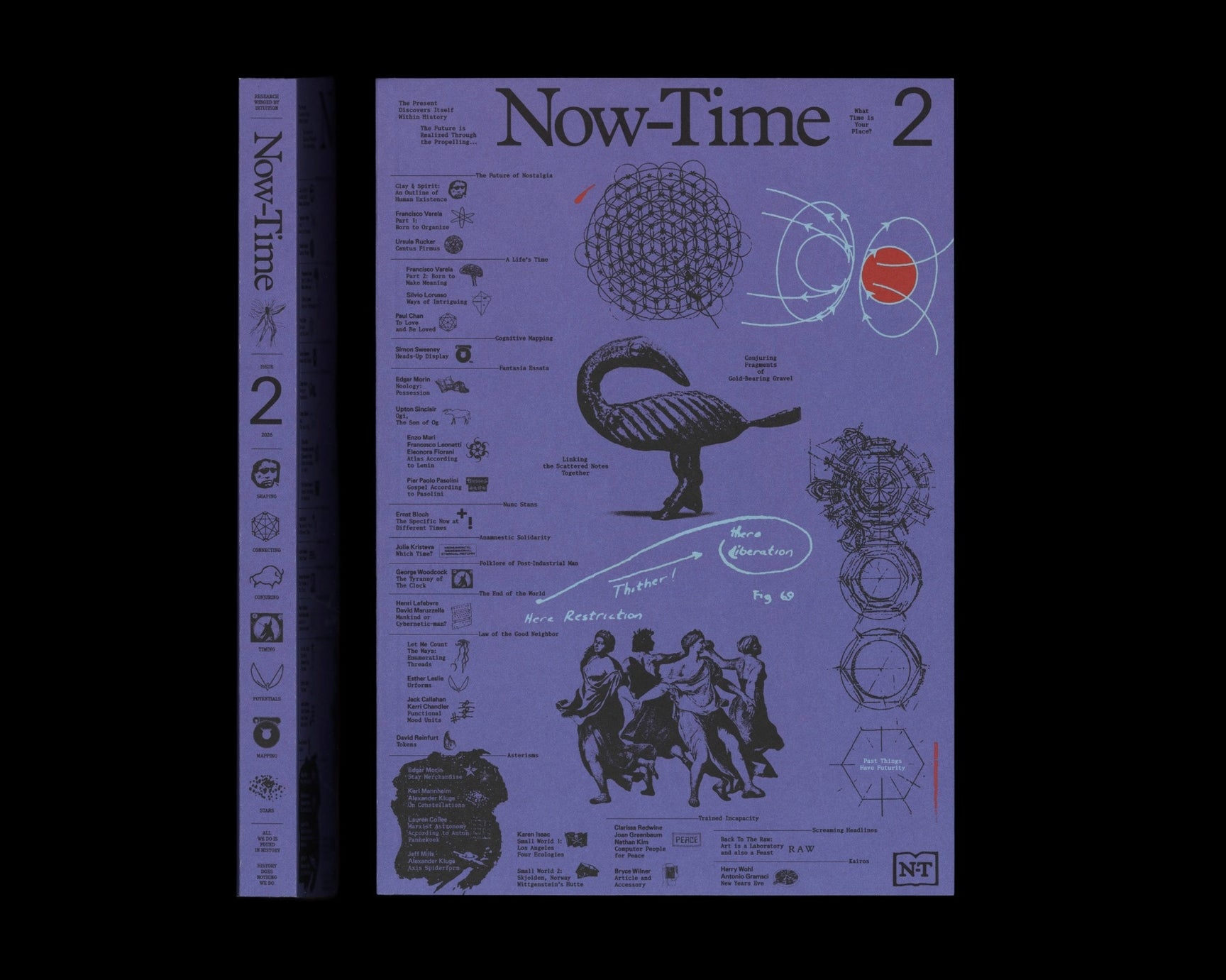
Essay included in Now-Time #2.
“The search for more persuasive ways to sell was summed up colourfully by a car salesman in Atlanta who said of his problem in selling cars in a then-slack market: ‘If buyer shopping gets any worse, we’ll have to hit the customer over the head and get him to sign while he’s unconscious.’ His use of the word unconscious, as we shall see, was unwittingly prophetic.” – Vance Packard1
“To acknowledge this ‘return of the repressed’ requires a model of design history that would allow for crossings, multiplicities, and correspondences that escape the generally-accepted periodicity and lines of influence.” – Mark Owens2
“Artistic skill is the combining of many levels of mind – unconscious, conscious, and external – to make a statement of their combination. It is not a matter of expressing a single level.” – Gregory Bateson3
“What is more persuasive than a slip of the tongue?” What better artifice, asks Jean-François Lyotard, can graphic artists contrive to intrigue, even if for a split second, the big, black beast we call the public? By devising a verbo-visual pun, the designer is able to briefly stun the ant eyes of frantic passersby, as the pun suddenly erupts from the city background like a thought they’ve already thought: “Perhaps there is a slip of the tongue in a good graphic design, the slip of the tongue that you the viewer were able to make with regard to the thing promised”.4
Denouncing the captivating self-evidence of the slip of the tongue, Lyotard follows in the footsteps of moralists like Vance Packard, who see graphic artists, copywriters, and others agents of the advertising industry as hidden persuaders. However, while Packard focused on the manipulative dimension of their activity, Lyotard engages with the graphic artist’s perilous and messy attempt at “making hypotheses” about the shifting desires of an invisible crowd. Lyotard doesn’t see graphic art as some sort of malicious prowess, but as a craft that requires a general attunement of affects. This is a process that no one fully controls, not just the public, but the graphic artist as well: “You may bore when you thought to move, you imagine yourself cynical and turn out to be authentic”.
This point of view is productive because it doesn’t sever the graphic artist from their audience. Lyotard doesn’t grant designers a kind of methodological invisibility, instead they are understood as part of “the combination, endlessly unmade and remade, of temporary sensibilities”. This systemic perspective allows us to see psychology differently: not only a device to gain prime access to the mind of the ‘user’, but a key to unlock what is unknown to both user and designer. With a similar idea in mind, I’ve been exploring the concept of the designerly unconscious, understood as “the ‘givens’ of a design culture, automatically employed and rarely questioned, without which (that) design culture would not exist as such. These are the conditions that make designerly thinking and knowing possible”.5
What does the whole designerly mind, and in particular its unconscious dimension, look like when it comes to graphic design? Freud’s iceberg model, with its various versions circulating online as .jpegs and .webps – part of the intrigue Lyotard was talking about –, helps us make sense of it. Most importantly, the iceberg is divided into three horizontal strata: at the top, the conscious (the tip of the iceberg); just below, the preconscious (the ice at water level); and beneath that, the unconscious (the mass submerged in the deep sea). Ascending from the ocean’s depths, we encounter the id (completely sunken and thus fully unconscious), the superego (mostly underwater but surfacing through the preconscious into the conscious), and finally the ego (almost entirely visible and therefore largely conscious).
Graphic designers’ ideas about graphic design collectively contribute to, but don’t exhaust, graphic design culture. For them, the totality of visual culture tends to coincide with graphic design, that is, with the conscious part of the discipline’s psyche. But not all visual culture is design culture: punkzines, a diner’s menu, Hildegard von Bingen’s miniatures… even the MAGA hat (which most design theorists and critics approached with condescension, except for Noemi Biasetton6) are something other than graphic design. Designers can quote them in their work, learn from them, but these ‘artifacts’ will always exceed design culture. Design is a part, not the whole.7 We are beginning to think of graphic design not as a total system of rigorous structuring principles but simply as one ‘aesthetic’ within the vast ocean of visual culture. And, what’s more, the field itself is in perennial reconfiguration, it experiences a constant identity crisis that fuels the crises of its practitioners: the aesthetic is fluid.
Graphic design doesn’t account for all of visual culture – so what does it account for? Following Freud’s model, the visible part of the iceberg is what I will call Graphic Design (not to be confused with graphicdesign). It is the explicit conceptual map of the field, its ‘moodboard’: Massimo Vignelli, grids, Helvetica, Pantone swatches, I <3 New York, brand guidelines, AGI, flat style, variable fonts, etc. This does not only include the rational-modern-orderly dimension of graphic design, but also its impulsive, post/antimodern, folkloric, defaultist reflex: manifesto writing, Ray Gun, Comic Sans and Papyrus, Geocities banners, picket signs, brat, etc.
I call graphicdesign the layer of the ego that is submerged in the preconscious. With this term I refer to those formations that are right under designers’ eyes and yet remain invisible to them. Elliot Ulm, Gilbert Again and Michael Oswell are particularly good at spotting these steganographic signs. Oswell, in fact, coined the term graphicdesign, but his purpose was slightly different. He wanted to obtain a Verfremdungseffekt: by giving ‘graphic design’ an almost identical name, he sought to estrange the familiar. Some examples of graphicdesign, as I understand it: the image that slightly overlaps the text in a magazine cover, asking “what’s the font?” when looking at something non-typographic like a work of calligraphy, superficial but effective differentiations like speed vs SPEED, wild logo constructions that opportunistically exploit the golden ratio, the camel case of brands like iPhone, eBay or the archeological AirBnB, the Bouba-Kiki effect… As Kevin McCaughey suggests, seen by an outsider some of these things could look like a form of “occupational psychosis”, since these are things only the designerly mind would be affected by – when non-designer normies see the designer noticing, they call them a nerd.
Also belonging to graphicdesign are the lifestyle items that populate the designer’s ‘starter pack’: the ever-present desk monstera, eye floaters, the field’s linguistic tics (such as working “at the intersection of”), short beanies, thick black glasses, and all the things “only graphic design can say with a straight face” (Gilbert) such as ethical is the new normal. It’s the average youthfulness of its practitioners. It’s the 10$ latte from the Corporate Memphis cafe. It’s Apple by default. It’s Azealia Banks calling graphic design “white people shit”.
Graphic design’s superego is to be found in the client, of course, but not the actual client (perhaps that’s located in the visible tip of the iceberg). Rather, it coincides with the symbolic function of the client, “the name of the client” in Lacanian terms. I’ll call it the inner client. The inner client has a negative, punitive, even sadomasochistic side: “make the logo bigger”, tight deadlines, self-imposed constraints, the libidinal charge of logo restrictions in brand guidelines… For McCaughey, enough real client trauma can engender a very rigid designer, a neurotic ruled by their own inner client. But this figure also has a positive, affirmative aspect. The inner client wants to raise awareness, it repeats mottos like “with great power comes great responsibility”, it believes in design ethics, justice and more recently care. The inner client is both “we must” and “you must not”. At its deepest layer, the superego simply represents the urge to impose order. As I wrote with Geert Lovink, Ned Rossiter and Mieke Gerritzen: “The growing superego absorbs the traditions of the family and the surrounding society, helping the child control aggressive impulses or socially unacceptable urges. […] The superego becomes the designer. This explains how creative freedom can be sacrificed in favor of meeting societal expectations. […] The term superego, translated from the German Über-Ich, can be somewhat misleading. The word ‘superego’ might make you think of self-glorification rather than feelings of shame and guilt when you do or think something that goes against the norms and values instilled during your upbringing”.8
The id is to design what outsider art is to the artworld. I won’t give it a design-related name for it consists of the so-called vernacular, that is, all the visual culture that hasn’t (yet) passed through the discipline’s filter: cursed images, blessed images, images that “go hard”, glitched panorama photos, courtroom sketches, fried chicken shop signs, trashy print-on-demand books, AI-generated posters – and obviously, memes. McCaughey rightly suggests that all of these artifacts point to a strong drive to communicate. But what does communication mean here? Make someone else feel what we want them to feel: intrigue them. That’s why the id craves texture.
Graphic design tried to subsume memes, but memes are ungovernable… and ended up subsuming graphic design instead. In fact, while graphic design always misunderstands memes, memes get graphic design better than itself. It turns out, graphic design was the outsider all along. The id is where the law of non-contradiction breaks down, where relationships overcome things. The id is a corrective to design’s narrow rationality or romantic irrationality. That’s dreamspace. This also explains why disorienting irony is so common: in a dream, unlike in a theater, there is no curtain, meaning that there is no meta-statement signaling that what’s happening is play.9
Ursula K. Le Guin spoke of poets and visionaries as “realists of a larger reality”. An understanding of the designerly mind attentive to its unconscious dimension might enable the practitioner (as well as the theorist) to become a designer of a larger design. Not to go back to shaky totalities, but to play a role in constructing a bigger picture, that is more vivid and detailed.10 This is partly because the designerly unconscious breaks the rigid professional/amateur divide. In fact, McCaughey goes as far as arguing that the designer might be better off shedding the ego of graphic design, that is, its professionalized image. While professionalism operates between the ego and the superego – that is, between Graphic Design and the inner client –, amateurism, dilettantism and the vernacular are to be found in the submerged zone where the preconscious meets the unconscious, within the strata of graphicdesign and the id. This zone is where the intrigue originates. And it is the feedback loop going through all those layers that enables the design practice to evolve, not without that strange, liberating feeling a designer feels when an amateurial design is recognized as an icon. Fortunately, such evolution is never complete: there will always be dark areas, because designers, as any human being, do not hold the larger design – they belong to it. This mode of belonging is never fully defined. Elucidating it is to approximate wisdom, to know of the unknown.
1 Vance Packard, The Hidden Persuaders, Harmondsworth: Penguin Books (Pelican), 1962, p. 26.
2 Mark Owens, “Graphics Incognito”, Dot Dot Dot, no. 12, February 2007.
3 Gregory Bateson, Steps to an Ecology of Mind: Collected Essays in Anthropology, Psychiatry, Evolution, and Epistemology, San Francisco: Chandler Publishing Company, 1972, p. 464.
4 Jean-François Lyotard, “Paradox of the Graphic Artist”, in Postmodern Fables, Minneapolis: University of Minnesota Press, 1997, pp. 33-47.
5 Silvio Lorusso, “Existential Solutionism: A Dive into the Designerly Unconscious”, Reclaiming Hope: Navigate (Un)certainty, Imagine Better Futures, Ivica Mitrović and Dora Vanette (eds.), Centre for Creativity.
6 Noemi Biasetton, Superstorm: Design and politics in the age of information, Eindhoven: Onomatopee, 2024.
7 Silvio Lorusso, What Design Can’t Do: Essays on Design and Disillusion, Eindhoven: Set Margins’, 2023, p. 102.
8 Silvio Lorusso, Geert Lovink, Ned Rossiter and Mieke Gerritzen, “Curb Your Enthusiasm: Design Beyond Guilt and Shame”, 2025, forthcoming publication.
9 Gregory Bateson, Steps to an Ecology of Mind, op. cit., p. 428.
10 See Carlo Bramanti, Conspiratorial Design: Information Design for the Bigger Picture, Eindhoven: Set Margins’, 2025.